Roblox Game Conversion Program: Roblox Will Convert Your Unity or Unreal Game for Free
Roblox has opened a program that converts existing games from Unity, Unreal or any other engine to Roblox — free, with you keeping the rights. Here is who can apply and what to know before you hand over your source code.

In this guide
What Roblox Announced How the Conversion Works The Three Promises That Matter Who Gets In First What Your Game Becomes on Roblox What to Prepare Before You Apply What the Announcement Does Not Say Frequently Asked Questions Is the Roblox game conversion program really free? Can I apply with a Unity or Unreal game? Do I keep my game if Roblox converts it? Will Roblox train AI on my code or assets? How long does a conversion take? What kinds of games is Roblox most interested in? Related Guides on RBXMods SourcesOn Monday, November 16, 2026, Roblox opened a door that was closed to most outside developers. Jim Greer, the senior director of Roblox Game Solutions, announced a new program: if you have a finished game built in Unity, Unreal or any other engine, Roblox will convert it to Roblox for you — free. You apply, Roblox does the conversion with its agentic tools, and you keep the rights to your game and to the Roblox version. Nothing goes live unless you choose to publish it. This guide explains what the Roblox game conversion program offers, who gets in first, what you hand over, and the questions the announcement leaves unanswered.
Key takeaways
- Announced Monday, November 16, 2026, by Jim Greer of Roblox Game Solutions. Applications are open to everyone, but the first wave is a limited group of developers and titles across mobile, PC and console.
- Roblox converts your existing game for free using agentic conversion tools; approved teams hand over source code and assets.
- You keep all rights to your game, your intellectual property and the Roblox version. Your code and assets will not be used to train or fine-tune AI models, and nothing is published unless you choose to publish it.
- Roblox is especially interested in genres and styles it does not have much of yet — a way to bring new kinds of games to its 140 million daily users.
- No turnaround time, fidelity guarantee, maintenance plan or revenue terms were stated in the announcement, so apply with your eyes open.
What Roblox Announced
The announcement came from Jim Greer himself, in a LinkedIn post on November 16, 2026, with trade press coverage the next day. Greer runs Roblox Game Solutions, and his pitch targets a specific frustration: studios want Roblox's 140 million daily users, built-in social features and fast iteration, but cannot pull a team off their existing games to do the port. His answer is to take the porting work off their hands entirely.
The offer is simple. Roblox says it has built agentic conversion tools — software that carries out much of the porting work itself — and is now opening the program to everyone. If you have a game on any engine, Unity, Unreal or custom, you can apply to have Roblox convert it. The conversion is free, the port is yours, and Roblox says it does not train AI on your code or assets. Greer added that Roblox is especially interested in genres and styles it does not have much of yet — a hint about who gets picked first.
That last line matters. Roblox already has more obbies, simulators and tycoon games than any player could finish, so a puzzle game, a narrative adventure or a genre that barely exists on the platform is a more interesting test case — and a more useful addition to its catalog. If your game is something Roblox players cannot already find ten versions of, your application is stronger.
How the Conversion Works
The process has four steps. First, you apply through the link in Greer's post — applications are open to everyone, so there is no invite-only gate. Second, Roblox selects who goes first: the first wave is a limited group of developers and titles spanning mobile, PC and console, and Roblox has not published selection criteria, capacity figures or a timeline for wider access. Third, if approved, you hand over what Roblox needs to rebuild the game: your source code and your assets. Fourth, Roblox performs the conversion and hands you a Roblox version of your game.
Publication is the part you control: nothing is published unless you decide to publish it, and the Roblox version stays yours, along with your original game and your intellectual property. That opt-in matters — you can see the converted game running before committing to anything public, and walk away with the port in hand if you decide not to ship it.
One thing to be clear about is what "agentic" means here. It does not mean a button that turns a Unity project into a Roblox place with no human involvement — it means software agents carrying out much of the conversion work, with Roblox's team behind them. The announcement gives no detail on how much is automated and how much is manual, and no converted game has been shown publicly yet, so the output quality is still unproven.
The Three Promises That Matter
Most of the announcement is really three commitments, written to answer the exact objections a cautious studio would raise before handing over its source code.
It is free. Roblox covers the full cost of the conversion. For a small studio with a finished game and no porting budget, that removes the biggest barrier: months of paid work on a platform you have never shipped on. For a larger studio with its own porting team, the price matters less than the terms that follow.
You keep your game. Ownership of the game, the intellectual property and the Roblox version stays with the developer at every stage. The port is yours, and so is the decision to publish it.
Your code is not AI training data. Roblox says it may use AI-assisted tools while working with your code, but the code and assets you supply will not be used to train or fine-tune AI models. That distinction is worth reading carefully: AI tools are involved, but your code does not become training material. Studios with strict code-handling rules should still see the full contract language before submitting anything — a LinkedIn post is not a contract.
Who Gets In First
Anyone may apply, but not everyone gets in at once. The program begins with a limited number of approved developers and titles, spread across mobile, PC and console — Roblox wants to test its conversion tools on a controlled set of real projects before scaling up.
What Roblox has not said is how that first group is chosen — no selection criteria, no capacity figures, no timeline for wider access. The one real signal is Greer's line about genres Roblox does not have much of yet. If you are deciding whether to apply now or wait, ask whether your game brings something Roblox does not already have: a polished game in an under-served genre fits the first wave better than the twentieth version of a genre Roblox already does well.
What Your Game Becomes on Roblox
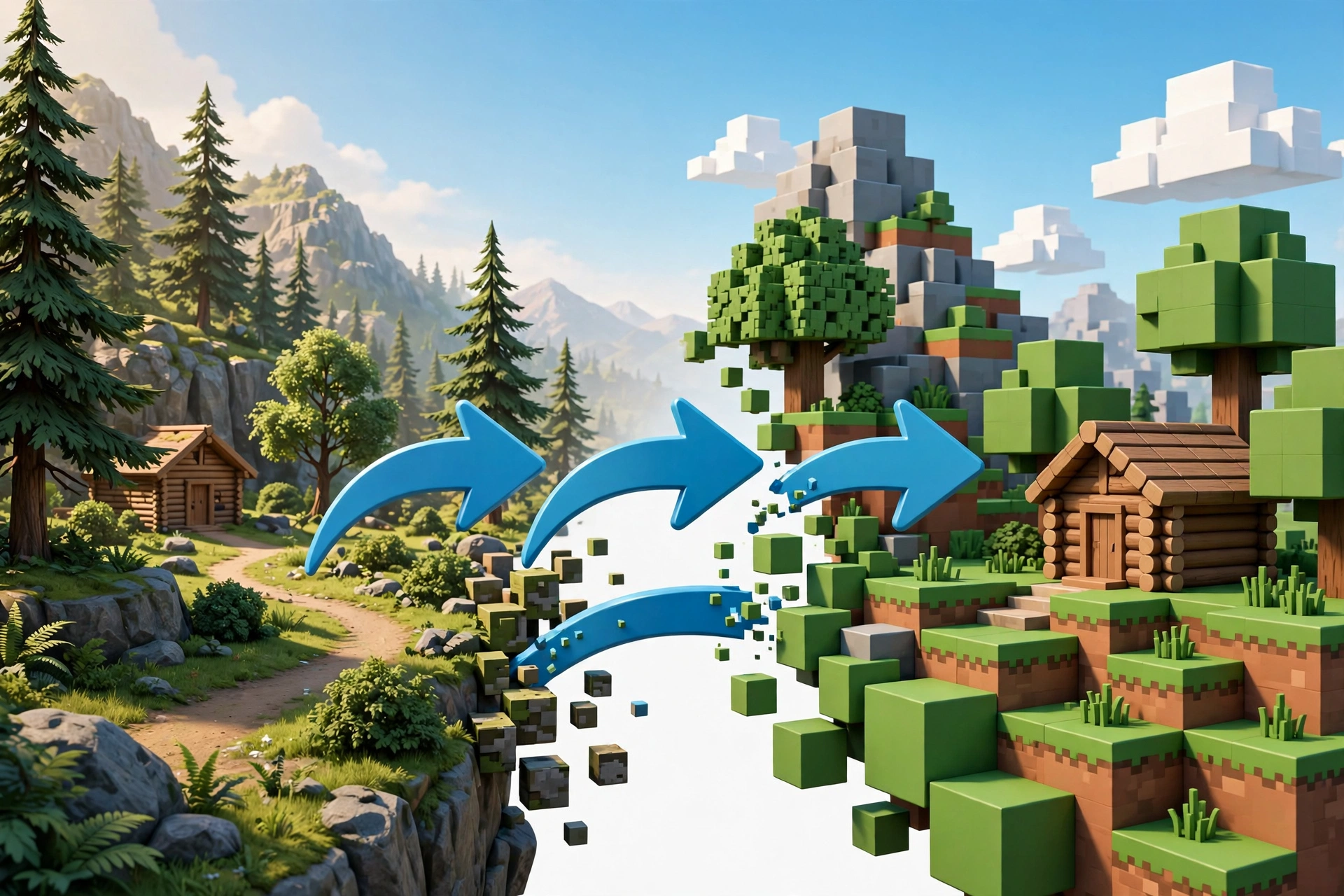
A converted game does not just change engines. A single-player game from a PC can become multiplayer by default, because it runs against Roblox's cloud, and a game that used to be a large download can be joined instantly and played on a phone. Roblox CEO David Baszucki described that shift in a November 2026 interview as "Robloxification": your single-player game becomes multiplayer by default, runs on a phone through 3D streaming, and gains access to Roblox's economy. That is the real prize behind the free port — not just a second platform, but a game that behaves like a Roblox game, found through discovery and friends inside the app rather than downloaded one by one.
The program also fits a wider pattern. In September 2026 Roblox introduced Everywhere, which lets creators ship games as standalone apps across platforms, and it has said creators will soon be able to switch on offline solo play, with early access first and a full release planned for mid-2027. The direction is clear: Roblox is opening up to games built outside Studio, not just inside it. The conversion program brings outside games in; Everywhere lets Roblox games go out.
That context cuts both ways. Your converted game gets Roblox's distribution and social graph — the point of the program — but it also lives by Roblox's rules: its Community Standards, its discovery system and its economy. A game that depends on something Roblox does not allow, or that cannot be expressed in Roblox's architecture, will need rethinking during the conversion, not after it.
What to Prepare Before You Apply
If you are thinking of applying, get four things straight first. None is a formal requirement in the announcement, but each one decides whether your application is realistic.
Make sure you own what you would submit. You will hand over source code and assets, so if your game uses licensed music, third-party art, middleware or code you do not own outright, sort out whether you have the right to share those with Roblox. Do not submit anything you cannot legally hand over.
Know which parts will not translate cleanly. High-end rendering, platform-specific services, custom networking and console-only features are the usual problem areas. A game whose core loop is simple and whose systems are self-contained converts more cleanly than one built around engine-specific tricks. Write down the three systems your game depends on most, and ask whether each one has an equivalent inside Roblox.
Decide what success looks like. Are you applying to reach new players, to test Roblox as a platform, or to give an old game a second life? The answer changes what you do with the converted version.
Keep your expectations about timing honest. There is no stated turnaround time, and the first wave is limited. Apply, then carry on with your existing plans — treat the conversion as a bonus, not a launch date.
What the Announcement Does Not Say
Four practical questions decide whether this program is useful to most studios, and the announcement answers none of them.
Turnaround time. No estimate was given for how long a conversion takes, from approval to a playable Roblox version — studios cannot plan a launch around a date that does not exist yet.
Fidelity. It is unclear how closely a converted game will match the original, or what happens to features Roblox cannot replicate — until converted games are shown publicly, fidelity is a promise, not a demonstration.
Maintenance. The announcement does not say who updates the Roblox version after launch, or whether patches to the original carry over. A converted game that never gets updated slowly rots — ask about this before you publish.
Revenue terms. Conversion is free, but nothing covers how a published converted game earns money, or what share Roblox takes. A free port shifts the cost question rather than removing it: if you publish, the economics of living on Roblox decide whether the move pays off. Get that answered before you commit to a launch, not after.
None of that makes the program a bad deal. A free conversion with ownership intact and opt-in publishing is a genuinely good offer, and for a small studio with a finished game it is hard to replicate on their own budget. The headline — free — is the beginning of the decision, not the end of it.
Frequently Asked Questions
Is the Roblox game conversion program really free?
Yes, as announced: Roblox covers the full cost of the conversion, and developers keep ownership of their game, their intellectual property and the Roblox version. No price, fee or revenue share for the conversion itself was stated in the announcement.
Can I apply with a Unity or Unreal game?
Yes. Games built on any engine — Unity, Unreal or a custom engine — can apply. The first wave is limited to a selected group of developers and titles across mobile, PC and console, so applying does not guarantee immediate acceptance.
Do I keep my game if Roblox converts it?
Yes. Roblox says you keep all rights to your game, and the port is yours. Nothing is published on Roblox unless you choose to publish it.
Will Roblox train AI on my code or assets?
No. Roblox says it may use AI-assisted tools during the conversion, but the code and assets you supply will not be used to train or fine-tune AI models.
How long does a conversion take?
The announcement does not say. There is no stated turnaround time, no published selection criteria and no timeline for wider access beyond the limited first wave.
What kinds of games is Roblox most interested in?
Roblox says it is especially interested in genres and styles that Roblox does not have much of yet. A polished game in an under-served genre is a stronger fit for the first wave than another version of a genre Roblox already does well.
Related Guides on RBXMods
- Roblox Incubator Program explained — the other program that funds and supports outside teams, this time for new 18+ games, with applications open until December 7, 2026.
- How to publish a Roblox game in 2026 — the publishing flow, audience settings and checks your converted game would go through before it can go live.
- How to make a game in Roblox — if you would rather build natively in Studio than convert an existing game, start here.
- How to use AI in Roblox Studio — the AI tools Roblox is building into creation, from the Assistant to agent workflows.
- Roblox Studio MCP and Open Cloud access — how outside AI tools connect to Studio, and the permissions that control what they can touch.
RBXMods is not affiliated with or endorsed by Roblox Corporation. Roblox and the Roblox logo are trademarks of Roblox Corporation.
Sources
Last checked against Roblox docs: November 19, 2026.
- Jim Greer (Roblox Game Solutions) on LinkedIn — the original announcement, November 16, 2026: the free conversion, any engine, you keep all rights, no AI training on your code or assets, and the interest in genres Roblox does not have much of yet. (Verified loading 2026-11-19.)
- GameDev.net: Roblox launches creator program for devs to bring games to its platform for free — November 17, 2026: the GamesIndustry.biz reporting on the limited first wave, source code and assets handover, and the Everywhere and offline solo play context. (Verified loading 2026-11-19.)
- GamesDle: Roblox will convert games from Unity, Unreal and other engines for free — November 17, 2026: the application flow, the AI-training distinction, and the open questions on turnaround, fidelity, maintenance and revenue. (Verified loading 2026-11-19.)
- Stratechery: An Interview With Roblox CEO David Baszucki About Aggregating Play — November 2026: Baszucki's "Robloxification" description of converted games, the universal player, and Roblox Everywhere. (Verified loading 2026-11-19.)
- Roblox Creator Docs — the official documentation hub for creators. (Verified loading in the live browser 2026-11-19.)